

— Communications Act 2003, UK Parliament
Openreach claim there are 350,000 business premises still with traditional analogue lines or ISDN. The deadline has been set for 31st January 2027, when they will be officially retired.
Tick tock, subliminally echoes the speaking clock throughout BT’s coincidentally timed advertising campaign. The reassuring voiceover provides a soundtrack that almost nobody, with any sense anyway, calls anymore. How much would that cost these days, to check the time is right on your mobile phone?
To be fair to BT Group, I like the advert a lot. An ex-employer close to my heart with a career spanning several generations on my mother’s side. Both my uncle and grandfather had long careers there before I joined BT Wholesale in 2007. It was the start of my telecoms career and I have the utmost respect for BT.
The Speaking Clock is still so recognisable today and that says everything there is to say about an ageing and distinguished brand. Not cool, but mature. It’s trustworthy.
Openreach, as a subsidiary of the wider group, not so much.
An extraordinary amount of revenue is still being generated from a copper network, while the last rites are being very publicly read. That sits rather awkwardly beside Ofcom’s promise to apply robust safeguarding for the end user.
For anyone working in UK telecoms the reason behind all this isn’t news. The old Public Switched Telephone Network is closing. Wholesale Line Rental, acronymised as WLR, is heading out the door with it. We have had many years to take action in the majority of cases.
WLR is the product that you will know as the traditional telephone line. Openreach owns the physical network but the provider issuing an end user invoice can sit several relationships further along the supply chain. This means the underlying technology stays the same while the commercial choices around it are removed.
I have no problem with the switch-off as a final destination. 20tele.com isn’t a traditional lines and broadband business, and its sister brand FreePBX UK certainly isn't. We are an experienced, independent VoIP provider and fixed lines are incidental to what we do. I have no interest in preserving copper voice. Quite the opposite, in fact. Moving voice away from copper and onto IP is where our business has been heading for years. The more the merrier.
That’s why I am comfortable criticising how the final part has been handled by Openreach and others. I want the migration to happen sooner rather than later. That doesn’t mean I have to agree with the Carrot Then Stick approach used to get there.
Some providers will undoubtedly have left far too much far too late. Some end user customers will have ignored every escalatory letter. Somewhere there will still be a trusty fax machine that apparently holds an entire octogenarian business together.
None of that changes my point and the deadline is the deadline. The pricing strategy is something else and it deserves continued scrutiny.
A Better Language
A fixed migration deadline is quite a powerful thing because there is ultimately no debate about the destination. You can move early or leave it late, that’s your prerogative. You can’t complain about it though, while simultaneously ignoring it for another five months. Eventually you are moving, kicking and screaming if that’s how you want it.
The telecoms industry has had years to prepare. There are replacement products aplenty and stop-sell arrangements arrived long ago. Can’t sell it, won’t sell it. We all removed analogue lines and ISDN from our websites. There were incentives and migration offers everywhere. Providers invested in equipment and customers moved. Personally, we spent the equivalent of a month’s line rental revenue on replacement routers. Ouch. As if the end user would pay for it; I wouldn’t dare ask them. I hope you didn’t. Shout out to TP-Link and ProVu for making the ideal router available in abundance, the versatile VX230v for less than £40 wholesale with a built-in ATA that just works. Job done. It deserves to win awards as the trusty go-to switch-off router for 2025-26. Where do I submit a nomination?
That is what an orderly transition should look like: manufacturers, distributors, and retailers joining forces. None of us would ever expect Openreach to foot the bill, why should they? Make the replacement technology attractive enough and help people get there. Remove any unnecessary barriers and give the industry enough certainty in the future to invest. Then, when enough has sold, prepare to close the door forever on the old product. Do it nicely, with a smile, a reassuring wave, onwards and upwards as we embark on this exciting journey of new possibilities.
Except the carrots were never wrapped in that idealistic picture of generational handover.
Part Fibre and Full Fibre eventually helped settle down some of the mouthfuls we expected customers to consume. Before that we had SoGEA, SoGFast and FTTP, which have all the bedside manner of a drunk dentist. Even experienced telecoms sales teams struggled to grasp what it all meant, never mind needing to explain it to someone who just wanted their phone and broadband to carry on working.
Very little effort went into marketing the change as something an ordinary end user might understand. Openreach assumed the telecoms industry knew what it all meant and CPs (Communication Providers) knew what they were ordering. Then, somebody had to explain to ordinary folk why the telephone line was disappearing while the broadband wasn’t.
We also had to explain why the number might need moving somewhere else and why the replacement for line rental no longer contained a native phone service. Some providers had never worked seriously with VoIP. It was new to them, even in 2025.
Providers figured it out with every half-proofed, pre-botched order. Retaining the number could feel like hit-and-hope. One side dealt with the broadband while the other dealt with the number port, or "integral transfer" to be more precise. No one really dealt with the line itself, probably because the losing provider had lost interest at that point and couldn't do anything about it anyway. If something went wrong there was just enough documented accountability on both sides for neither side to feel ultimately responsible.
Perhaps the porting process should have been overhauled years ago. It wasn’t. Providers had to deal with the end user while everyone else, including BT, argued amongst themselves. I can’t tell you how many hours were lost waiting for completion.
That is what providers are paid to do: translate SoGEA and FTTP into something friendly that customers probably understand. So, we explained Part Fibre and Full Fibre and took our cut. We reassured customers that their number wasn’t about to disappear while praying it didn’t. We called it things like Broadband + Calling Capability. Catchy.
Let’s not forget, often the exact same copper lines are now being used in a voiceless form for VoIP. It’s the equipment on the end that’s changing, and they’ve taken something away from the bit you “rent”. Make sense?
Pressure Finds Form
Somewhere towards the end of this journey, price rises became increasingly important. Not through general inflation, or because of a modest adjustment that might make a new product look more attractive, but as a deliberate means of changing behaviour..
An Openreach representative referred to embracing “Nudge Theory”, publicly, and a 20% increase was announced for WLR Basic rental from April 2026. Another increase followed in July. By October the rental is double the late-2025 rate. In the context of a decade, charges will have almost tripled.
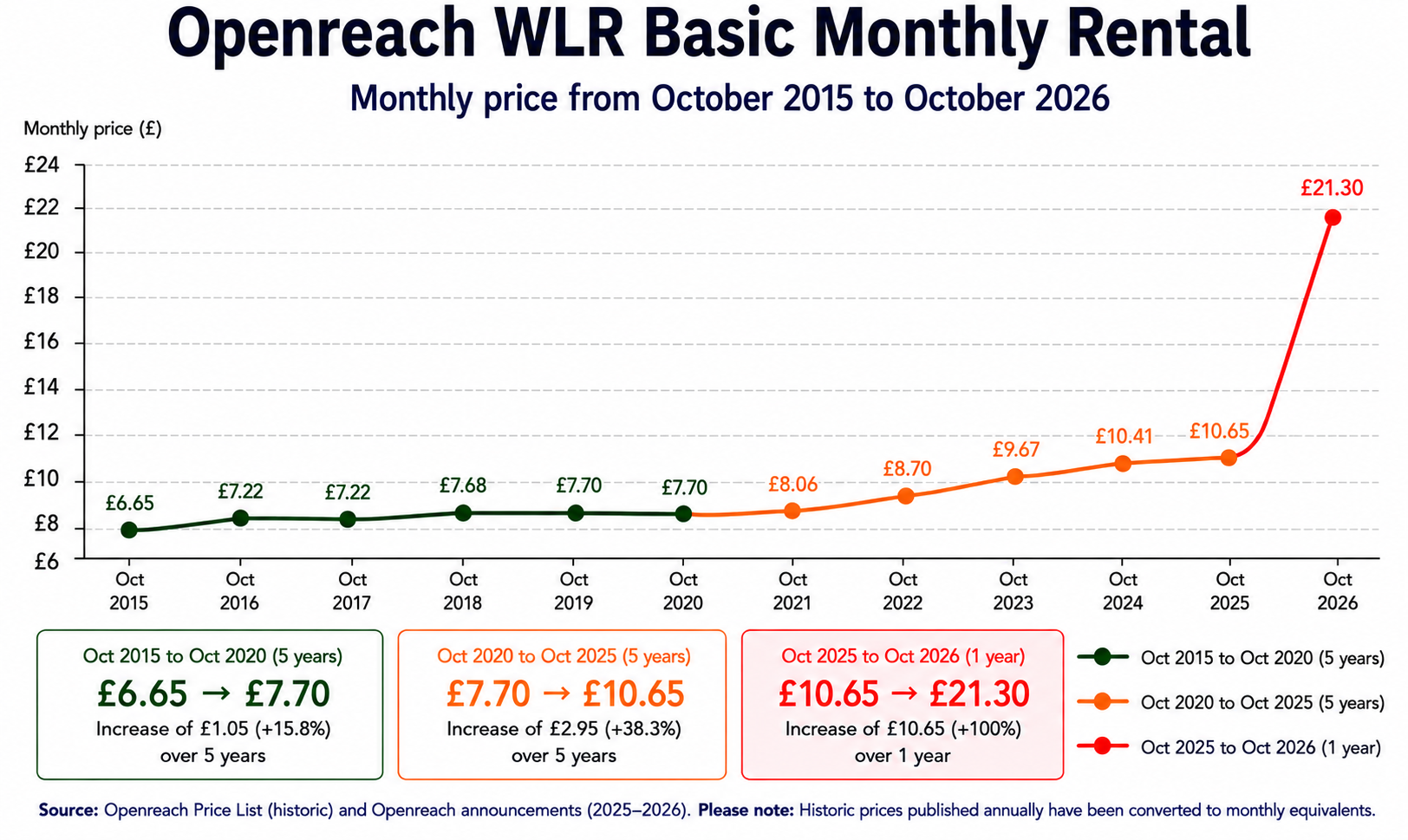
Openreach has been explicit about why, to all who will listen. The increases are intended to send CPs a clear signal to migrate customers. Deregulation gave Openreach greater pricing freedom once charge controls were removed. Ofcom did not stop it.
This means the increased prices aren’t simply an unfortunate consequence of migration. They became central to the migration strategy. It looks less like an equal game of chess and more like a game of Monopoly, where the banker can change rent prices whenever he wants to influence a player’s decisions.
That is where the ethics become questionable. Openreach assumes someone already knows what the right decision is, and if you have not made it by now, you need their help to get there. Cometh the stick. Critics of Nudge Theory have described it as treating people less like rational adults and more like subjects to be managed. Andreas Schmidt and Bart Engelen go further, arguing that nudges “fail to treat us like rational human beings and thereby condescend and infantilize us.”
Quite. Before landing on the work by Schmidt and Engelen in my research for this article, I had posted on LinkedIn “We know the date. We heard you. You don't need to treat us or our end users like children.”
Pointed comments in reply to my post prove it. “Responsible Communication Providers like Zen Internet have known for a long time they needed to address this issue."
Responsible is a word being used with loaded intent there, so I will answer it. Zen had 18,000 customers yet to migrate at the end of May 2026. If those numbers remain the same in October, Zen will be paying Openreach an additional £191,700 a month, or almost £1 million if they did nothing for the duration. Seriously, for what? It looks like a punishment.
These numbers are astonishing when you consider there are hundreds of responsible and irresponsible CPs. Openreach bears almost none of the operational complexity to complete the final, difficult migrations, yet it controls the wholesale price lever being used to force them. They don’t send the end user a bill. Some CPs buy directly while many others buy through wholesalers or distributors. Resellers then buy from them and eventually someone sends the invoice to the person actually using the service.
A price increase sounds wonderfully simple from the top of a supply chain. Put the price up and eventually the customer moves. Except, that isn’t how the telecoms industry works and Openreach is in a significant position of influence and should know better.
Every business in the supply chain has costs. There is billing and support, staff and systems. Consider too the long leases for unoccupied square footage that still needs light, heat, and power. Something needs to be done about the lost revenues, at least during the transitional period. Economies of scale are not designed to flow backwards and that basic economic logic is being forced into reverse.
Percentage increases grow in cash terms as the underlying amount increases. A 20% increase on £10 is £2. A 20% increase on £20 is £4. If each layer in the supply chain protects its own margin by percentage, the effect compounds. If Openreach expected a simple monetary pass-through from its wholesale increases to the end user, it made a monumental miscalculation.
Imagine a farmer increases the price for a pint of milk by 10p. That does not mean the customer pays the supermarket another 10p. The processor has its own costs and margins, so does the distributor, and so does the retailer. By the time the milk reaches the shelf, that original 10p increase might have become 25p. The farmer did not increase the retail price by 25p. Another 15p was added as businesses further down the supply chain made their own commercial decisions.
Every layer in between has its own costs, margins and decisions to make, including finance departments with their own fiscal responsibilities. That is why pointing at the headline Openreach price misses much of the commercial reality. A service that once cost a reseller £10 a decade ago can increase fourfold as the economics move through the supply chain. Today, 20tele’s buy price has reached £40 and it could climb higher still.
£15 to £20 to £40 in just three years, since the start of the stop sell. It’s easy to understand how our supplier took us there: Openreach pulled the price lever and the layers underneath had to react.
CPs and resellers, like 20tele, could choose to pass on the increase pound-for-pound. They could preserve existing margin or reduce it or take advantage and increase it. They could even absorb the cost completely, but why should they? They are in business to make profit, not charitable gestures. They also need to provide sufficient notice to their customers and any billing lag could get very costly indeed. Then, do it all again when the next increase arrives.
The provider also has to explain it downstream, as if those conversations carry no cost. How long would it take Zen to have meaningful two-way conversations with the remaining 18,000 customers? How much does that time cost? What does that time take them away from? It’s an enormous effort for a remaining customer base that has already ignored previous requests, warnings, threats and punishments.
I focus on Zen because they were presented to me as a responsible example. They are, and they have been open about their migration position and the challenges they face.
20tele chose to remain credible while explaining that the service they have already been told is disappearing has become dramatically more expensive in the meantime. We did it with complete transparency and shared our buy price with affected end users. We absorbed the increases once they breached our sell price in 2024 until it became unsustainable. In 2025 we reluctantly went to wholesale cost pass-through and continue to make zero margin. I wonder how many other providers did that. If a provider increased profits with every price rise, they would welcome the changes. Zen publicly welcomed the price increases. Do Openreach care, either way?
At the time of writing, we have four lines remaining and all four are due to be ceased. Everything else was migrated in a smooth and orderly manner.
Check. Check. Checkmate.
There is another problem for hundreds of reputable resellers who don’t buy WLR directly from Openreach. They buy through a CP, in a respectable and traditional wholesale-supplier arrangement. That worked perfectly well when WLR was a regulated product under normal market conditions. CPs competed for price-sensitive reseller business, and resellers had some choice over which terms suited them better.
Towards the end of 2023, that well-heeled freedom eventually evaporated. That is to say, doing as you please because you can afford it. Every reseller was stuck by the start of the stop-sell, frozen in time. It didn’t matter that the technology hadn’t gone anywhere. The copper still ran overhead and underground, with no physical signs of its withdrawal.
As far as Openreach is concerned, the underlying product and end user customer is unchanged. So, why do they care so much to prevent the transfers? If a CP passes on another price increase, and another, and another, no one can move the billing elsewhere. Our supplier is doing exactly that and building in plenty of headroom to boot, smartly insuring against unexpected increases. Openreach knew what would happen and did it anyway.
Normally, when a supplier puts the price up, a reasonable response is to shop around. This competitive pressure matters and it’s one of the things that stops a supplier doing whatever the hell it likes with price. Here, Openreach deliberately removed that freedom with three years still to go. Not knowing it would be extended from December 2025 to January 2027 is a shameless excuse, and an unbelievable one.
Price was allowed to become a stick used to accelerate that withdrawal, affecting millions of businesses. It was ethically wrong.
Openreach knows how its CPs go to market, that’s its business model. It knows large CPs operating as wholesalers supply extensive reseller channels. Hundreds of businesses sit between Openreach and the end user who ultimately pays for the service. The less competition there is, the more important regulation becomes. Extraordinarily, regulation designed to protect the end user was stripped away. Its absence enabled price increases to be used as a means to an end.
You can see why Openreach did it, even if you don’t understand or agree with it. There is a temptation to assume the remaining lines are simply a collection of businesses and providers who ignored all the warnings. Many undoubtedly did and some still are. The final ten percent are unlikely to be the easy ones though. Straightforward customers tend to move first.
What remains is likely to involve alarms, lifts, card machines, and the ongoing need for emergency failover. I know, because we have customers with all of the above. For these customers in particular, cease is more likely than migration, but Openreach’s strategy makes no allowance for that. If the line is being ceased, there is no need to encourage migration. Those customers should be protected from price pressure. Make them fully aware the line will be ceased and see how many agree. Pending Cease should be a declared status, but no one ever asked us. Guess how long the end user wants to wait? That’s right, as long as possible.
Your move, Openreach.
Businesses of all sizes built critical systems around fixed telephone lines when doing so was entirely normal. This wasn’t reckless. It was entirely responsible. They bought equipment and signed contracts around infrastructure the industry itself sold as dependable.
There are certainly laggards. But there should be no debate that it’s a customer’s right to be a laggard. There are also wholly responsible businesses caught in awkward edge cases.
Six Pound Fuel
Perhaps telecoms is too close to home for most readers, so let’s imagine the same principle in an unrelated industry, with a similar transition most of us are likely to experience directly.
A fixed date has already been set, and soon new petrol and diesel cars will no longer be sold in the UK. The end of an era. Manufacturers are almost entirely investing in electric vehicles, and most company fleets have already started leasing the new cars. Charging infrastructure is growing rapidly, and people will have years to make decisions around a timetable that has already been set out by the government.
Now, imagine, as the deadline approaches petrol is deliberately pushed towards £6 a litre. Not because the cost of oil has suddenly increased fourfold but because making fuel costs painful becomes part of the policy for getting people into electric cars faster.
Suppliers and petrol stations will claim their livelihoods needed to be protected and blame a collapsing customer base. There it is again, those reverse economies of scale rearing their ugly head. The critics will scoff, “You’ve had years to get yourself to a showroom and buy an electric car. Irresponsible!”
It’s a shame a new electric car costs the equivalent of a modest mortgage less than 30 years ago. Wages have not risen at the same rate. What about those who can’t afford it, when an £800 used car could have made a basic standard of living possible? Electric cars will never reach that level of affordability. Perhaps those people will take the bus.
The government says it isn't banning the used car market, nor our ability to drive petrol and diesel cars. Well, that’s alright then. I doubt they will protect prices at the pump, though. Along with the CMA, who watches forecourt prices, they will turn a blind eye.
You might support the green agenda completely and still think such an approach would be wrong. The argument isn’t about whether petrol and diesel should eventually disappear. It wouldn’t be about whether electric cars are better, relatively affordable, or whether people had been given enough notice. It would be about using punitive pricing to force the final phase of a transition in a highly regulated market.
Petrol at £3 a litre might move people. £6 would move them even faster. At some point that friendly word "encouragement" starts doing some heavy lifting. And who really benefits?
If you can’t buy new petrol and diesel cars, their used counterparts will eventually end up in the scrap heap or sold for parts. They don’t make ‘em like they used to! So, what’s the point of putting fuel prices up? The inevitable is inevitable.
It all sounds very familiar to what we are seeing in telecoms with the Great British Switch Off.
Even the name helps soften the edges. Baking in a television series' trademark and dressing it up as a national celebration, rather than the withdrawal of infrastructure that businesses and consumers have relied on for generations. There is something almost whimsical about the cheery branding of a process that involves paying more to unpick critical services before the old network switches off for good.
Planning The Pain
A shrinking network costs more to maintain per customer because many fixed costs remain while fewer people are paying for it. If maintaining a dwindling copper network was always going to become exponentially more expensive, then that should have been uncovered during the planning stages. The switch-off hasn’t appeared from nowhere. It has been years in the making with forecasts and consultations. There have been migration programmes and regulatory oversight.
If those rising costs were known, then the pricing path should have been built into the plan and communicated from the start. If they weren’t known, then we have a different problem. It starts to look less like an unavoidable consequence and more like corporate mismanagement at the highest level. This wasn’t an unknowable problem. The possibility that the economics would change as the estate declined should have been part of the planning.
If late-staged price rises were always going to form part of the final migration strategy, they should have been part of the plan from the beginning. Proposed, consulted on, regulated and published. Providers could then have modelled the financial path years ahead and had one honest conversation with customers instead of several increasingly uncomfortable ones.
I struggle to understand why the resulting price increases should now be treated as a useful migration tool instead of something a regulator ought to scrutinise. A regulator shouldn’t endorse a painful outcome simply because the pain happens to accelerate a policy objective. Ofcom should be asking why the pain was necessary in the first place.
If deliberately raising the cost of yesterday’s infrastructure is accepted as a reasonable way to move customers onto tomorrow’s infrastructure, then we should at least be clear that this is the precedent being set. I am not suggesting Openreach has necessarily broken a rule. My problem is that apparently the rules allow this.
Ofcom may consider the outcome acceptable. I don’t.
Trust Is Spent
Telecoms professionals, of all shapes and sizes, have spent years asking end users to trust them. We tell a business that a service which appears to work perfectly well needs to change and ask them to believe us. We explain why replacement equipment really is necessary and why this isn’t simply an excuse to sell something new.
As a startup that began trading in 2015, 20tele has experienced the trust landscape shift. In little more than a decade, acquiring disgruntled customers has become a less important strategy than keeping the ones you have. Customers know what they want and they know how to get it. They trust the process. That trust now matters because a good provider doesn’t want to bully customers into buying things. We need customers to agree when we say change is genuinely necessary.
Repeated shocks make that much harder than it needs to be. Another supplier email arrives and there is another conversation. The price increase needs explaining with a polite encouragement to move. The encouragement becomes increasingly firm. Eventually the customer starts wondering whether all of this is really necessary or whether everyone in the supply chain has simply spotted an opportunity to make more money. In truth, many are. At some point the distinction between Openreach’s decision and the wholesaler’s margin stops mattering to the customer. They only see the provider they have a direct relationship with. The reseller is expected to stand in front of the customer and somehow make the whole thing feel reasonable. The weight of that responsibility is oddly one-sided.
There also needs to be consideration for existing end user contracts where downstream price increases weren't permitted in the first place. The fallout as customers came out of a fixed term en masse, to move now or else, would be tremendous. An industry that has regained trust in many respects has made a hash of the switch-off. That is particularly disappointing because the process has ultimately been directed by an organisation whose historic relationship with market dominance and regulation is hardly uncomplicated. That should have demanded more scrutiny rather than less. Ofcom dropped the ball. Openreach ran off with it.
The relationship doesn’t finish when WLR does.
Tearing apart trust to get the final few percent over the line might make perfect sense on a boardroom whiteboard. I'm less convinced it makes sense as a long-term business decision.
Carrot Then Stick
There is an old idea in influencing behaviour. The carrot makes the desired outcome attractive while the stick makes the alternative unattractive. Used in moderation, both can work.
Unfortunately, the proverbial stick got bigger and bigger. Faster migration was the desirable outcome. Openreach couldn’t control every awkward customer, but it could control price and that eventually became the easiest, most convenient lever to pull. This is a fantastic example of overreach.
Providers will remember the supplier emails and difficult customer conversations. Customers will remember being told again that the cost had changed and they needed to move faster. None of that stops the migration succeeding. It changes how people feel about the organisations involved.
Goodwill won’t appear in the completion statistics. You can close a network and hit the target while still leaving the people who helped you get there feeling bruised by the process.
The goodwill may be gone for good.
Kieran
This blog post was published as a LinkedIn article here.


Paying For Free